



The Fifth Sunday in Lent

This is a story full of delays, grief, disappointment, tenderness, and—somehow—hope. It is a story where people who love God still suffer. It is a story where Jesus shows up late. And it is a story where death does not get the last word.
When Jesus finally arrives in Bethany, his friend Lazarus is dead. The professional mourners have already come. The casseroles have already been delivered. The house smells like grief. And Martha meets Jesus with one of the most honest prayers in all of Scripture: “Lord, if you had been here…”
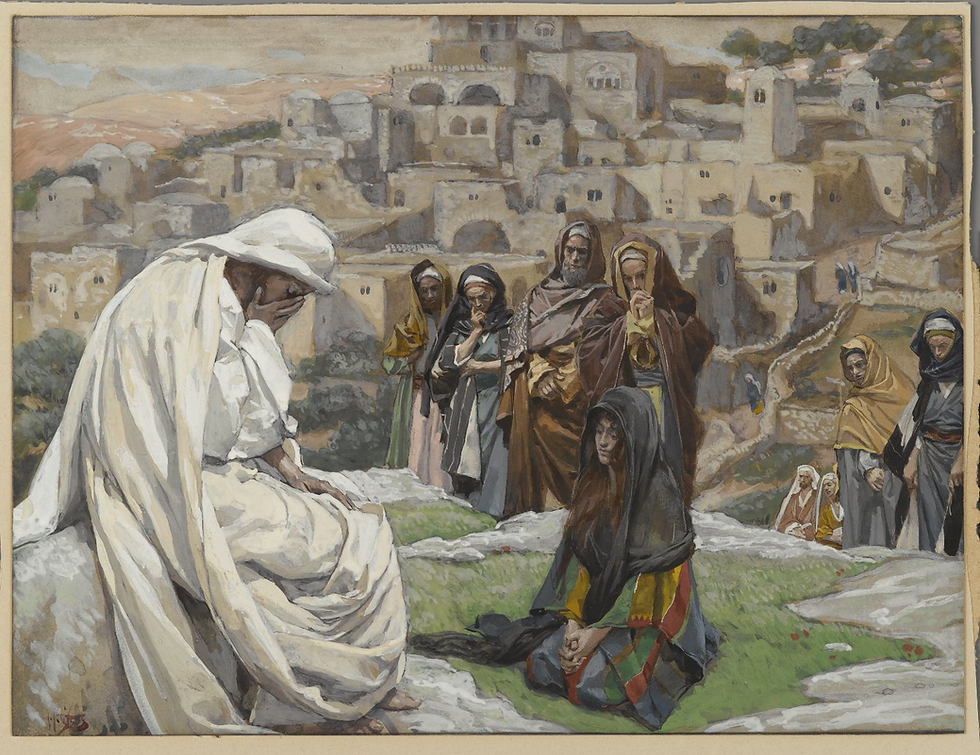
Martha is not punished for her honesty. She is met with presence. Mary comes out, falls at Jesus’ feet, and says the exact same thing. Same words. Same pain. Same disappointment. Jesus does not correct her. He does not make excuses. He does not say, “Everything happens for a reason.” He weeps. The shortest verse in Scripture is one of the deepest: “Jesus began to weep.”
The underlying Greek word for “wept” in the original text gives us a much better picture. In our sanitary approach to such things, we might imagine a single tear running down his face. What the Greek text gives us is that Jesus burst into tears. His entire body shook with deep emotion.
The text says Jesus is “greatly disturbed in spirit”—a phrase that means something closer to outraged, shaken, indignant. Jesus is not angry at the mourners. I don’t think Jesus was just crying about his friend’s death.
I think his tears were about the tragic frailty of life, the senseless death of young life, the randomness of death, the loss of any loved one, at any time, any place. He is angry at death itself. At the systems and forces that steal life. At the way the world breaks hearts. This is not a God who shrugs at injustice. This is a God who confronts it.
John’s account describes a typical Jewish burial. Wrapped in linen strips, Lazarus’ body was buried the same day he died; his tomb a cave, sealed with a stone, outside the village. His sisters then began the customary 30 days of mourning at home, receiving the condolences of their friends and neighbors.
By the time Jesus arrived, Lazarus was dead four days, the point at which the rabbis claimed no trace of the soul remained in the body. Decomposition had set in. He would not have been a pretty sight nor smelled very good.
Then Jesus says something wild: “Take away the stone.” Martha protests—because she knows what death smells like. She knows what four days in the tomb does to a body. She knows that opening the tomb means facing the truth.
But Jesus insists. And then he cries out with a voice that echoes across centuries: “Lazarus, come out!” And Lazarus does. Notice something important: Lazarus comes out still bound—hands, feet, and face wrapped in grave clothes. And Jesus turns to the community and says: “Unbind him, and let him go.”
We don’t know exactly what happened next in this story, but I bet there was a big party that night with lots of food and wine and dancing.
Legend has it that Lazarus was thirty when Jesus restored him to life and lived another 30 years. What if we were given an extra thirty years to live? What would we do with it? What would we do differently?
We may be inclined to think that the most potent words in this passage are found in the roaring command of Jesus, “Lazarus, come out.” I don’t think so. That is a directive intended for the deceased. John tells us that “the dead man came out, his hands and feet and face bound with strips of cloth.” I think the most powerful words we hear in this text are “Unbind him and let him go!” These are words meant for the living. They were addressed to the bystanders, his friends—to us.
What binds us? Inhibits us? Obstructs and encumbers us? The resurrection of Lazarus is evidence that Jesus moves among us to give us life, to untie and release and unshackle us from whatever keeps us locked up and constrained.
You know every generation has its tombs. Tombs of despair. Tombs of violence. Tombs of exhaustion. Tombs of fear. Tombs of injustice that feel too old, too deep, too sealed to ever be opened.
And yet the voice of Jesus still calls: “Come out.” Come out of the narratives that say nothing can change. Come out of the shame that keeps us small. Come out of the fear that keeps us silent. Come out of the grief that has become our address.
And then Jesus hands the work to us: Unbind one another.

Unbind the neighbor who can’t breathe under the weight of life. Unbind the friend who has forgotten their worth. Unbind the stranger who has been wrapped in systems that diminish them. Unbind the world from the grave clothes of violence, apathy, and despair.
Resurrection is not a private event. It is a communal calling. The miracle is God’s. The unbinding is ours.


Comments